
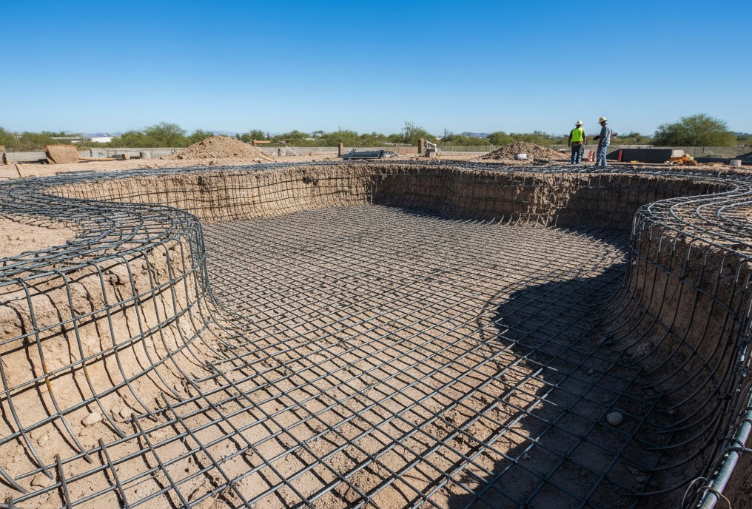
Pool inspections in Arizona don’t fail randomly—they fail for predictable structural reasons.
In nearly every failed inspection, the issue traces back to the same phase of construction:
Improper rebar installation.
Across Phoenix, Scottsdale, Chandler, and the greater Valley, inspection failures are most commonly caused by:
- Incorrect rebar spacing
- Insufficient clearance from soil
- Weak or inconsistent tying
- Poor adherence to engineered plans
These are not minor issues—they are structural failures in the making.
For pool builders and contractors, this means:
- Delays
- Re-inspections
- Increased labor costs
- Long-term liability
Understanding why inspections fail—and how to prevent it—is critical to maintaining timelines, margins, and reputation.
Why Pool Inspections Fail in Arizona
Arizona presents one of the most demanding environments for pool construction in the country.
Between extreme heat, expansive soils, and rapid moisture changes during monsoon season, structural reinforcement must be executed precisely—not approximately.
1. Improper Rebar Clearance
Rebar must maintain proper distance from surrounding soil and formwork.
Standard requirement:
- Minimum 3 inches of clearance from earth contact
When rebar is placed too close to the surface:
- Moisture reaches the steel
- Corrosion begins
- Expansion leads to cracking and structural failure
This is one of the most common causes of failed inspections.
2. Incorrect Rebar Spacing
Rebar spacing is dictated by engineering—not preference.
Typical spacing ranges:
- 6” to 12” grid patterns, depending on design and soil conditions
When spacing is:
- Too wide → structural weakness
- Too tight → unnecessary material + potential inspection flags
Even small inconsistencies across the grid can trigger inspection failure.
3. Inadequate Tie Integrity
Every intersection in a rebar grid must be properly secured.
Inspectors routinely perform:
Physical stability checks (“shake tests”)
If the structure shifts:
- The cage lacks integrity
- The installation fails
Loose ties lead to movement during shotcrete application, compromising the entire shell.
4. Failure to Follow Engineered Plans
Every pool build includes engineered specifications tailored to:
- Soil conditions
- Load requirements
- Structural design
Deviating from those plans—even slightly—can result in:
- Immediate inspection failure
- Long-term structural issues
5. Soil Conditions Not Accounted For
Arizona soil is not uniform.
- Expansive clay (East Valley)
- Caliche (North Scottsdale)
- Variable compaction (Central Phoenix)
Each condition requires:
- Specific reinforcement strategies
- Adjusted spacing and support
Ignoring soil behavior leads to:
Movement → Stress → Cracking
6. Job Site Sloppiness
Inspectors evaluate more than just structure.
Common issues that raise red flags:
- Debris in forms
- Loose wire or unsecured steel
- Inconsistent layout
These signal poor workmanship—and often result in closer scrutiny or failure.
Pool Inspection Checklist (Pre-Shotcrete)
Before scheduling inspection, every builder should verify:
Structural Checklist:
- Rebar spacing matches engineered design
- Minimum 3” clearance maintained throughout
- All intersections securely tied
- Bond beam properly reinforced
- Steel cage fully stable (no movement)
Site Readiness:
- No debris inside forms
- Layout consistent and aligned
- Bonding wire properly installed
- Engineering plans available if required
This checklist alone can significantly improve first-pass success rates.
What Inspection Failures Cost Builders
Inspection failure is not just an inconvenience—it’s a direct hit to profitability.
Typical impacts:
- 3–7 day delays (longer during peak season)
- Crew rescheduling and downtime
- Equipment extension costs
- Increased labor expenses
Worst-case scenarios:
- Failed installation discovered post-shotcrete
- Demolition and rebuild costs: $15,000–$30,000+
- Reputation damage with clients
The takeaway:
Structural mistakes are exponentially more expensive than doing it right the first time.
Rebar Placement Standards for Pool Construction
While every project varies, consistent structural principles apply:
Key Standards:
- Uniform grid spacing based on engineering
- Consistent clearance from soil and forms
- Reinforcement at stress points (corners, transitions, bond beams)
- Secure tying at all intersections
- Adaptation to soil conditions
Precision at this stage determines:
The long-term performance of the entire pool shell
How to Pass a Pool Inspection the First Time
Builders who consistently pass inspections follow a disciplined approach:
- Execute exactly to engineered specifications
- Maintain strict spacing consistency
- Ensure complete tie integrity across the grid
- Keep the job site clean and inspection-ready
- Work with experienced rebar professionals who understand local requirements
Success is not guesswork—it’s process-driven execution.
Why Builders Choose Scholz Rebar
Scholz Rebar has been supporting pool construction across Arizona since 1984, working with builders, contractors, and developers who prioritize structural integrity.
What sets us apart:
- Deep understanding of Arizona soil conditions
- Precision-driven installation methods
- Consistent first-pass inspection success
- Efficient installation timelines (most projects completed in one day)
- Experience across all Valley municipalities
We don’t just install rebar—we ensure the structure performs as intended.
Frequently Asked Questions
Does a pool need rebar?
Yes. Rebar provides the structural reinforcement necessary to prevent cracking, shifting, and long-term failure.
What are the most common rebar mistakes?
Improper spacing, insufficient clearance, weak ties, and failure to follow engineered plans.
What happens if rebar is installed incorrectly?
It can lead to inspection failure, structural cracking, and costly repairs or rebuilds.
Do gunite pools require rebar?
Yes. Gunite and shotcrete pools rely on rebar reinforcement to maintain structural integrity.
Build It Right the First Time
Rebar installation represents a small percentage of total project cost—but it determines the long-term success of the entire structure.
For builders, the decision is simple:
Precision now—or problems later.
Work With a Team That Understands Structural Performance
Scholz Rebar partners with pool builders and contractors across Arizona to deliver reliable, inspection-ready reinforcement for every project.
Contact us today to discuss your next build.